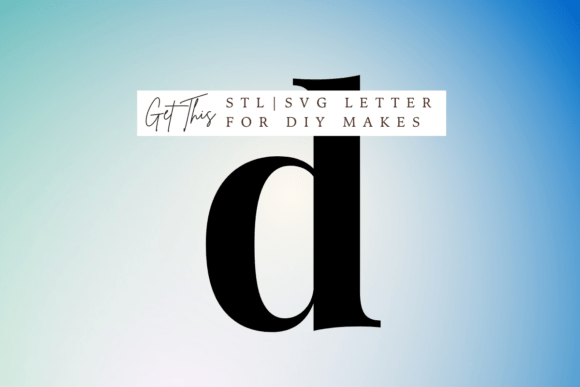
Playfair Lowercase Letter D SVG STL: A Practical Guide for Digital Makers
In the rapidly evolving landscape of digital fabrication, selecting the right vector asset is often the difference between a mediocre project and a professional-grade creation. The Playfair Lowercase Letter D SVG STL represents a specific intersection of typography, file versatility, and manufacturing precision that appeals to a wide range of hobbyists and professionals. Unlike standard fonts that exist solely on screen, this digital download offers a dual-format solution designed specifically for physical production. It combines the elegant, high-contrast serif aesthetics of the Playfair Display typeface with the technical requirements of 3D printing, laser cutting, and CNC machining.
Understanding the distinct value of this asset requires looking beyond the visual appeal of the letter itself. It involves evaluating how the file formats interact with different machinery, the dimensional accuracy required for assembly, and the flexibility needed for various material applications. Whether you are crafting personalized signage, intricate cake toppers, or detailed jewelry components, the decision to use a specialized SVG and STL package over a generic font file carries significant implications for your workflow and final output.
Defining the Asset: From Vector Paths to Solid Models
The core distinction of the Playfair Lowercase Letter D SVG STL lies in its dual nature. For users unfamiliar with the technical nuances of digital design, it is important to understand that these two formats serve fundamentally different purposes, even when they represent the same character.
The SVG (Scalable Vector Graphic) component consists of mathematical paths that define the outline of the lowercase 'd'. This format is resolution-independent, meaning the curves remain perfectly smooth regardless of how much you scale them up or down. This makes the SVG version indispensable for 2D manufacturing processes. When preparing files for laser cutters, vinyl plotters, or CNC routers that operate on flat sheets of wood, acrylic, or metal, the SVG ensures that the machine reads clean lines without pixelation or jagged edges.
Conversely, the STL (Stereolithography) file converts those 2D outlines into a 3D mesh. In this specific product offering, the STL measures approximately 5.5 inches tall by 5.5 inches wide by 1.5 inches thick. This thickness is a critical specification. Standard 3D printer slices often rely on layer height to build volume, but pre-generated STL files like this one provide a solid model ready for slicing software. This eliminates the need for users to manually extrude text, ensuring consistent wall thickness and structural integrity before the print even begins.
Evaluating Use Cases Across Manufacturing Methods
The versatility of the Playfair Lowercase Letter D SVG STL allows it to fit into numerous categories of DIY projects, but each application demands a different approach to material selection and tooling. Understanding these nuances helps makers choose the right method for their vision.
- Laser Cutting and Engraving: For wooden signs or acrylic displays, the SVG format is the primary driver. The sharp serifs of the Playfair font can be challenging to cut if the vector paths are not optimized. A dedicated file ensures that the delicate connections between the vertical stem and the curved bowl of the 'd' are preserved. This is particularly vital for thin materials where structural weakness could lead to breakage during the cutting process.
- 3D Printing: When using the STL version, the 1.5-inch thickness provides substantial depth. This is ideal for creating stand-alone objects like custom keychains or jewelry pendants. The thickness also allows for texturing or adding mounting holes without compromising the letter's shape. However, the tradeoff here is that the file is fixed in size; unlike a scalable font, you cannot easily resize the STL without re-slicing or importing it back into modeling software.
- CNC Machining and Wood Carving: For deeper engraving tasks, the combination of formats is useful. A maker might use the SVG to generate a toolpath for a V-bit to carve the letter into a plank, while the STL serves as a reference for the desired depth profile. The serif style of Playfair adds a level of sophistication that sans-serif fonts often lack, making it a preferred choice for formal signage or luxury packaging.
Comparative Analysis: Specialized Files vs. General Fonts
When researching options for digital fabrication, a common dilemma arises: should you purchase a specialized file pack like the Playfair Lowercase Letter D SVG STL, or simply download a free OpenType font and convert it yourself? While the latter option appears cost-effective, it introduces several variables that can affect the quality and safety of the final project.
Structural Integrity and Connectivity
Free fonts are designed for readability on paper or screens, not necessarily for physical isolation. When converting a standard font to a 3D object, the "counter" (the enclosed negative space inside the 'd') can become a floating island if not properly managed in the slicing software. Dedicated STL downloads often come with pre-managed topology, ensuring that internal features are either solid or correctly supported. Similarly, in laser cutting, the connection points of complex letters like 'd' must be robust enough to survive the cutting process. Generic conversions often result in weak bridges that snap off during post-processing.
Dimensional Consistency
The specific dimensions provided in this asset—5.5 inches by 5.5 inches with 1.5 inches of depth—are tailored for specific project scales. If you attempt to scale a generic font file to match these exact proportions, you risk distorting the aspect ratio or altering the stroke weight, which can ruin the aesthetic balance of the serif font. Using a pre-sized file guarantees that the visual weight of the letter remains true to the designer's intent.
Time Efficiency and Workflow
For experienced makers, generating their own models is a quick task. However, for those new to CAD or 3D printing, the learning curve associated with extruding text, managing boolean operations, and checking for non-manifold geometry can be steep. Purchasing a verified file removes this barrier, allowing the user to focus on the creative aspects of the project, such as material selection and finishing techniques, rather than troubleshooting file errors.
Weighing Tradeoffs and Limitations
While the Playfair Lowercase Letter D SVG STL offers significant advantages, it is not a universal solution for every scenario. Makers must consider the limitations inherent in fixed-size assets.
Scalability Constraints
The most notable limitation of the STL component is its fixed geometry. If a project requires a letter that is significantly larger or smaller than the 5.5-inch base, the STL cannot be resized directly without losing fidelity. In contrast, the SVG retains its scalability. Therefore, for large-scale wall art or miniature jewelry, the SVG is the superior choice, whereas the STL is best reserved for medium-sized decorative items.
Material Compatibility
The elegance of the Playfair font relies on fine details. When working with certain materials, such as coarse-grained wood or low-resolution 3D printing resins, these fine serifs may not reproduce well. The 1.5-inch thickness helps mitigate this by providing a buffer against material imperfections, but it does not guarantee success with all substrates. Makers must evaluate whether the grain direction or layer adhesion of their chosen material will support the intricate curves of the letter.
Strategic Decision Making for Makers
Choosing the right resource ultimately depends on the specific goals of the project. If the objective is to create a single, high-quality prototype or a limited-run batch of identical items, investing in a specialized Playfair Lowercase Letter D SVG STL is often the most prudent path. It reduces the risk of technical failure and ensures a polished aesthetic that aligns with the sophisticated look of the serif typeface.
However, if the project involves mass customization where every letter needs a unique size or orientation, a parametric approach using a full font library might be more appropriate. In this case, the ability to script or programmatically adjust the geometry outweighs the convenience of a pre-made file.
For the majority of DIY enthusiasts, jewelry designers, and small business owners producing signage or decor, the balance of convenience, quality, and versatility offered by the dual-format Playfair asset makes it a compelling option. It bridges the gap between digital design and physical reality, providing a reliable foundation upon which creativity can flourish. By understanding the strengths of both the SVG and STL formats within this package, makers can confidently select the right tool for their next creative endeavor, ensuring that the final product matches the elegance of the original design.