Unlocking the Power of Market Tags: The Ultimate Tool for Retail Branding and Sales
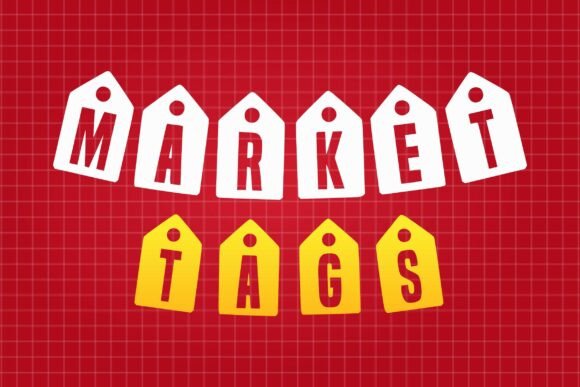
In the bustling world of commerce, capturing attention is not merely an advantage; it is a survival necessity. Whether you are managing a high-end boutique, organizing a chaotic garage sale, or designing a digital storefront, the visual language you choose dictates how your audience perceives value. This is where Market Tags emerges as a transformative element in graphic design. Far more than a simple font choice, this typeface reimagines typography as a tactile experience, turning every letter into a classic price tag silhouette. By leveraging this clever and playful concept, businesses can instantly communicate excitement, value, and a compelling "buy-and-sell" theme to their customers.
The psychology behind shopping is deeply rooted in visual cues. We are conditioned to associate specific shapes and colors with discounts, deals, and opportunities. When a consumer sees a standard sans-serif font on a flyer, they process it as information. However, when that same text is rendered in Market Tags, the brain immediately categorizes it as a transaction. Each character, encased in its own unique tag shape, creates a rhythm of anticipation. It suggests that something tangible is being offered, something worth purchasing. This immediate shift from passive reading to active engagement is why the typeface has become a favorite for retail branding, sales promotions, and market signage across various industries.
The Anatomy of Attention: Why Shape Matters
To understand the efficacy of Market Tags, one must look at the structural integrity of the letters themselves. Unlike traditional typefaces where characters float freely on a baseline, Market Tags anchors every glyph within a defined boundary. This silhouette mimics the physical tags found on merchandise in a department store or the labels on items at a craft fair. The result is a font that feels heavy with purpose yet light with fun. It possesses a "retail-ready" energy that standard fonts often lack.
This design choice serves a functional purpose beyond aesthetics. In crowded environments—be it a physical marketplace or a scrolling social media feed—clutter is the enemy of clarity. The distinct outline of each tag acts as a visual separator, ensuring that words do not blend into one another. This separation enhances readability while simultaneously drawing the eye to individual components of a message. For instance, a headline like "SUMMER SALE" does not just state a fact; it looks like a collection of discounted items waiting to be claimed. This subtle psychological nudge is what makes the typeface so effective for seasonal banners and window displays.
- Visual Consistency: Every letter maintains a uniform height and weight due to the tag container, creating a balanced and professional appearance even with playful subject matter.
- Tactile Illusion: The design tricks the eye into perceiving depth and texture, making digital graphics feel more physical and grounded.
- Immediate Context: The moment the viewer sees the font, they know exactly what the context is: commerce, pricing, and opportunity.
Strategic Applications Across Industries
The versatility of Market Tags allows it to transcend specific niches, serving professionals, hobbyists, and business owners alike. Its ability to adapt to different mediums makes it a robust tool for anyone looking to emphasize a commercial theme without resorting to clichéd stock photography.
Digital Marketplaces and E-Commerce
In the digital realm, where users scroll past hundreds of products in seconds, standing out requires aggressive yet smart design. Using Market Tags for product descriptions, "Add to Cart" buttons, or promotional pop-ups can significantly increase click-through rates. Imagine a flash sale notification where the word "FLASH" is rendered in the font; the tag silhouettes create a sense of urgency that mirrors the ticking clock of a limited-time offer. It reinforces the idea that time is running out and value is fleeting. For e-commerce platforms, this font helps bridge the gap between the sterile nature of screens and the excitement of in-store shopping.
Physical Signage and Window Displays
For brick-and-mortar stores, the transition from online to offline is seamless with this typeface. A boutique's window display featuring prices and brand names in Market Tags invites passersby to imagine the texture of the goods inside. It turns a static glass pane into an interactive invitation. Garage sale flyers benefit immensely from this approach as well. Hand-drawn signs are charming but often lack polish; printed signs using Market Tags offer a professional edge while retaining the community-focused vibe of a local event. The font tells the story of a treasure hunt, encouraging people to browse through piles of items with a sense of discovery.
Craft Fairs and Artisan Markets
Creatives who sell their work face the challenge of balancing artistic expression with commercial appeal. Market Tags offers a solution that respects the handmade nature of the products while clearly communicating their cost. When used on price cards, booth backdrops, or packaging stickers, the font aligns perfectly with the ethos of small-scale commerce. It suggests that the item was made with care but is also available for purchase. This duality is crucial for vendors who want to maintain their artistic identity while driving sales.
Color Theory and Visual Impact
A font is only as powerful as the environment in which it lives. To maximize the potential of Market Tags, color selection is paramount. The design guidelines for this typeface explicitly recommend pairing it with bright, high-contrast colors. The classic combination of red and yellow is perhaps the most potent, echoing the signage of major retail chains and fast-food establishments. Red triggers urgency and passion, while yellow evokes optimism and visibility. Together, they create a "retail-ready" energy that ensures your message is seen across a crowded room.
However, the application of color should be strategic. If the background is white or light gray, a bold red fill for the tags with black text inside will make the message pop. Conversely, for a darker, more premium aesthetic, one might use deep navy or charcoal backgrounds with gold or silver tag outlines. The key is to ensure that the silhouette of the tag remains distinct against the backdrop. High contrast is not just about style; it is about accessibility and legibility. In a busy market setting, a low-contrast sign is a silent sign—one that goes unnoticed. By utilizing the full spectrum of vibrant hues, designers can ensure that the "value and excitement" intended by the typeface are communicated instantly.
- Red and Yellow: The quintessential duo for clearance events, big-box store promotions, and high-energy sales.
- Black and White: A monochromatic approach that leans into a modern, minimalist streetwear vibe, perfect for urban boutiques.
- Pastel Palettes: Soft pinks, mint greens, and baby blues can soften the commercial edge, ideal for children's markets or spring collections.
Implementation Considerations for Designers
While Market Tags is a powerful asset, it requires thoughtful implementation to avoid visual fatigue. Because the font is inherently busy—with every letter containing an internal structure—it should not be overused. Using it for entire paragraphs of body text can be overwhelming and difficult to read. Instead, reserve the typeface for headlines, subheadings, call-to-action buttons, and key data points like prices or percentages.
When integrating the font into a layout, consider the whitespace around it. The tag silhouettes have a natural "weight," so surrounding them with ample negative space allows each character to breathe and stand out. Avoid cramming too many elements together. Furthermore, when scaling the font, ensure that the internal details of the tags remain crisp. On large outdoor banners, the resolution must be high enough to preserve the clean lines of the tag edges. Blurry tags lose their impact and can appear unprofessional.
Another consideration is the tone of the message. While the font is excellent for sales and promotions, it may not be suitable for serious corporate communications or solemn announcements. The playful nature of the design signals informality and enthusiasm. Therefore, it is best paired with content that celebrates abundance, deals, and new arrivals. It is the voice of the shopkeeper shouting "Look here!" rather than the lawyer drafting a contract.
The Future of Typographic Commerce
As the retail landscape continues to evolve, blending physical and digital experiences becomes increasingly important. Consumers expect immersive interactions that go beyond flat images and standard text. Market Tags represents a step toward this future by adding a layer of narrative to typography. It transforms the act of reading a price into the act of seeing a product. This shift is particularly relevant in an era where "shopping" is often synonymous with "browsing."
By adopting tools like Market Tags, creators and businesses can tap into a universal understanding of commerce. They don't need to explain that a sale is happening; the font itself does the explaining. It bridges the gap between the creator's intent and the consumer's expectation. Whether it is a startup launching a new clothing line or a non-profit holding a fundraising gala, the ability to visually communicate "value" is a critical skill. The Market Tags typeface provides that skill set in a package that is both accessible and impactful.
In conclusion, the decision to use Market Tags is a strategic move that prioritizes communication efficiency. It acknowledges that in a noisy world, the way we present our messages is just as important as the messages themselves. By turning letters into tags, we invite our audience to engage, to imagine, and ultimately, to buy. It is a testament to the power of design to influence behavior, proving that sometimes, the smallest details—the shape of a letter, the color of a tag—can make the biggest difference in the bottom line.