Wonderful Schedule: A Friendly Typeface for Organized Creativity
In a digital landscape often dominated by sterile, rigid, or overly aggressive typography, there is a distinct need for fonts that bridge the gap between structure and warmth. Enter Wonderful Schedule, a display typeface that has quietly carved out a niche for itself among designers, educators, and content creators who value both legibility and personality. This font is not merely a collection of letters; it is a visual tool designed to bring an organized yet organic flow to any project that requires a touch of cheerfulness without sacrificing clarity.
The Visual Identity of Wonderful Schedule
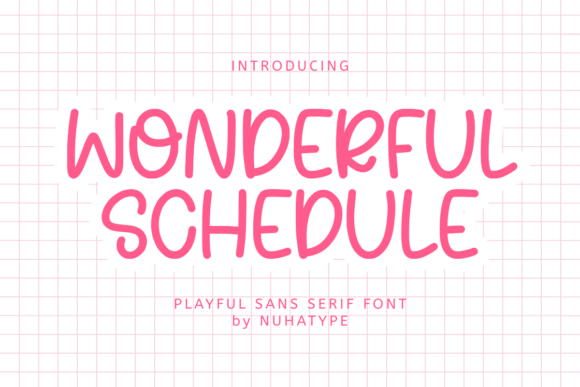
At first glance, Wonderful Schedule captures attention through its distinctive monolinear letterforms. Unlike traditional serif or sans-serif fonts that rely on varying stroke weights to create emphasis, this typeface maintains a consistent line width throughout every character. This uniformity creates a sense of balance and stability, making the text feel grounded and reliable.
However, what truly sets Wonderful Schedule apart is its bouncy baseline. While most professional fonts adhere to a strict horizontal alignment, this typeface introduces a subtle, rhythmic undulation to the bottom of the letters. This feature gives the text a playful, almost dancing quality, as if the words are moving forward with enthusiasm. It transforms a standard headline into an experience, inviting the reader to engage with the content in a more relaxed manner.
The design philosophy extends to the terminals and joins. The soft, rounded edges eliminate sharp corners, ensuring that the font feels approachable and safe. Furthermore, the smooth character joins prevent any awkward gaps or clashing lines, resulting in a seamless visual flow. These open counters—the negative space inside letters like 'o', 'e', and 'a'—are generous and well-proportioned. This architectural choice is critical for high legibility, ensuring that even at smaller sizes or from a distance, the text remains crisp and easy to read.
Why Structure Meets Softness Matters
The combination of thick, monolinear strokes and soft terminals addresses a common challenge in design: how to be fun without being childish. Many "friendly" fonts suffer from being too irregular or difficult to decipher. Wonderful Schedule avoids this pitfall by maintaining a strong underlying grid. The consistent stroke weight ensures that the text does not look wobbly or unstable, while the rounded details add the necessary human touch. This duality makes it exceptionally versatile for projects that need to convey authority while remaining accessible.
Practical Applications Across Industries
Understanding where a typeface fits best is just as important as understanding its visual characteristics. Due to its unique blend of organization and whimsy, Wonderful Schedule finds natural homes in several specific sectors. It is particularly effective in environments where information needs to be digestible but also engaging.
- Creative Planners and Journals: For individuals organizing their lives, schedules, and goals, the friendly nature of this font reduces the intimidation factor of planning. Using Wonderful Schedule for headers in a bullet journal or a digital planner can make the task of scheduling feel less like a chore and more like a creative activity.
- Educational Materials: In classrooms and learning resources, engagement is key. Whether designing worksheets, flashcards, or classroom signage, the clear legibility and approachable aesthetic help young learners focus on the content rather than struggling with complex letterforms.
- Youth-Oriented Branding: Brands targeting children or teenagers often struggle to find fonts that don't look cheap or overly corporate. Wonderful Schedule offers a modern, polished look that resonates with younger audiences while still appearing professional enough for business use.
- Social Media Graphics: In the fast-paced world of social media, visuals must stop the scroll. The bouncy baseline and thick strokes make headlines pop against busy backgrounds, ensuring that key messages are noticed immediately.
Real-World Scenarios
Consider a local community center launching a new summer camp program. They need flyers that communicate safety and organization but also excitement and fun. A standard corporate font might feel too cold, while a handwritten script might appear unprofessional. Wonderful Schedule strikes the perfect balance. The thick letterforms ensure the dates and times are readable from across a room, while the rounded, bouncy style conveys the joy of the activities offered.
Similarly, imagine a wellness app developer creating an interface for a daily mood tracker. The goal is to encourage users to check in with themselves without feeling judged. By using Wonderful Schedule for the app's titles and prompts, the design team can create an atmosphere of support and positivity. The open counters allow for quick scanning of data, which is essential for user retention in mobile applications.
Evaluating Suitability for Your Projects
While Wonderful Schedule is a powerful tool, it is not a one-size-fits-all solution. Like any typeface, it has strengths and limitations that designers should consider before committing to a full project.
- Ideal for Headlines and Display Text: Because of its heavy weight and decorative baseline, this font is best used for headlines, titles, posters, and short phrases. It may become visually overwhelming if used for long blocks of body copy. The "bouncy" nature of the letters works best when given space to breathe.
- Limited Character Set Considerations: As a display font, it may not offer the extensive ligatures or alternate glyphs found in more complex type families. Users requiring highly specialized punctuation or multilingual support should verify the available character set before purchasing or downloading.
- Contextual Appropriateness: The cheerful tone of Wonderful Schedule makes it unsuitable for contexts requiring extreme gravity, such as legal documents, emergency services, or solemn memorials. In these scenarios, a more neutral and serious typeface would be the prudent choice.
Making the Right Choice
When evaluating whether to incorporate Wonderful Schedule into your workflow, ask yourself about the emotional response you want to evoke. If the goal is to create a sense of order that feels welcoming rather than restrictive, this font is likely an excellent fit. Its ability to maintain high legibility while adding character means it can elevate simple designs into memorable experiences.
For professionals seeking to differentiate their brand, the consistency of the stroke weight provides a reliable foundation, while the soft terminals add a layer of uniqueness that generic fonts lack. It is a typeface that says, "We are organized, but we are also human."
Conclusion
Typography is more than just a vehicle for text; it is a silent communicator of tone and intent. Wonderful Schedule exemplifies how a well-designed typeface can enhance user experience by combining structural integrity with visual warmth. Its thick, monolinear forms and bouncy baseline create a distinctive identity that stands out in crowded digital spaces.
Whether you are a teacher preparing lesson plans, a business owner crafting social media posts, or a creator designing a personal planner, this font offers a practical and aesthetically pleasing solution. By choosing Wonderful Schedule, you are opting for clarity, approachability, and a touch of joy in your communication. In a world that often demands our attention through noise, sometimes the most effective message is one delivered with a smile—and a perfectly balanced baseline.